
I Got Tired of Nearshore Vendor Guessing, So We Built a Replacement.

By Lonnie McRorey, CEO & Co-Founder, TeamStation AI
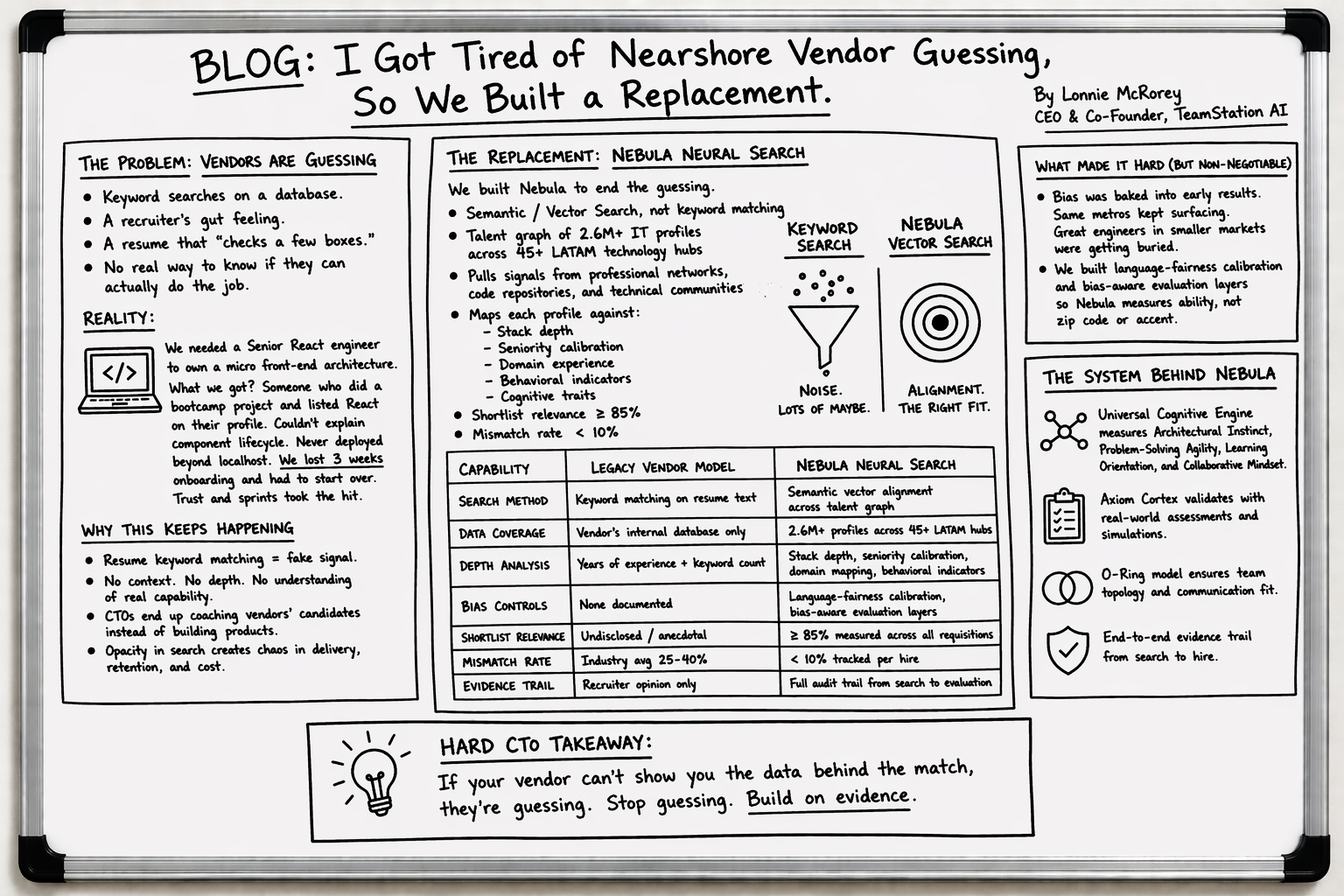
Over the past 25 years I have sat on both sides of the nearshore staffing table, as the client getting burned and as the operator trying to fix what was broken. And the one thing that kept showing up in every bad engagement I witnessed or inherited was this: the vendor had no real way to find the right engineer for the job. They were guessing. Keyword searches on a database, a recruiter’s gut feeling and a resume that checked a few boxes. That was the whole system.
I remember one engagement where we needed a senior React engineer who could own a micro front-end architecture for a product serving millions of users. What showed up was someone who had touched React in a bootcamp project and listed it on their profile. That person could not walk through a component lifecycle, could not explain state management and had never deployed anything beyond localhost. We lost three weeks onboarding them before we had to start the search over. The business paid for that in delayed sprints and a client relationship that got real shaky real fast.
That experience, multiplied across dozens of engagements with different vendors over the years, is what led me to build Nebula Neural Search inside TeamStation AI. As Dan Diachenko and I wrote in our book Platforming the Nearshore IT Staff Augmentation Industry, the old ways of finding and engaging tech talent are broken at the root, and no amount of recruiter hustle fixes a system that was never designed for precision in the first place.
Why Resume Keyword Matching Keeps Wasting Everyone’s Time
Here is what most people in this industry do not want to say out loud. The majority of nearshore staffing platforms still match candidates to roles using keyword searches. The client says “React, Node, PostgreSQL” and the system returns every profile in the database that has those three words somewhere on the page. There is no context. There is no depth. There is no understanding of whether that person used PostgreSQL to build a production data layer or just followed a tutorial on YouTube.
I have talked with CTOs across the United States who tell me the same story. They get a shortlist from their vendor, the resumes look decent, and then the technical screen reveals that the skill depth is not even close to what was represented. Engineering leads end up spending more time coaching, teaching and guiding the vendor’s candidates than building the product, which delays critical deliverables and frays the trust between teams.
The model needed to change from the ground up. I wrote about every failure mode I encountered over two decades in our CTO Playbook, and the pattern is always the same: opacity at the search layer creates chaos downstream in delivery, retention and cost.
What Nebula Does That Nobody Else Was Willing To Build
Nebula Neural Search is a semantic alignment engine that we built on top of a talent graph covering over 2.6 million IT profiles across more than 45 technology hubs in Latin America. We pull data from professional networks, code repositories and technical communities, and the system maps each profile against stack depth, seniority calibration, domain experience and behavioral indicators that go way beyond what a resume can tell you. You can see how Nebula fits into our full integrated services stack where sourcing, vetting, devices, payroll and compliance all run under one SLA.
The difference between Nebula and a keyword search is the difference between asking “does this person have the word React on their profile” and asking “can this person actually own a front-end architecture at the level my team needs right now.” Nebula answers the second question. That is why our shortlist relevance sits above 85 percent and our mismatch rate has dropped below 10 percent. Those numbers come from tracking every single requisition through the platform and measuring what actually happened after the hire.
In the book we describe this as moving from Boolean keyword matching to operating in vector space, where we infer latent traits rather than scanning for surface-level labels. Our System Doctrine lays out the science behind this, what we call the Universal Cognitive Engine model, which measures Architectural Instinct, Problem-Solving Agility, Learning Orientation and Collaborative Mindset across every candidate Nebula surfaces.
Legacy Vendor Model vs. Nebula Neural Search
Capability
Legacy Vendor Model
Nebula Neural Search
Search Method
Keyword matching on resume text
Semantic vector alignment across talent graph
Data Coverage
Vendor's internal database only
2.6M+ profiles across 45+ LATAM hubs
Depth Analysis
Years of experience + keyword count
Stack depth, seniority calibration, domain mapping, behavioral indicators
Bias Controls
None documented
Language-fairness calibration, bias-aware evaluation layers
Shortlist Relevance
Undisclosed / anecdotal
≥85% measured across all requisitions
Mismatch Rate
Industry avg 25-40%
<10% tracked per hire
Evidence Trail
Recruiter opinion only
Full audit trail from search to evaluation
The Bias Problem We Refused To Ship Around
The hardest part of building Nebula was not the data or the algorithms. It was the bias. Early versions of the engine kept surfacing the same profiles from the same major metros over and over again while qualified engineers in smaller markets across Colombia, Argentina and Mexico got buried in the results. We saw it happening, and we knew that if we shipped the product like that we would just be automating the same inequities that recruiters had been practicing manually for decades.
We spent months building language-fairness calibration and bias-aware evaluation layers into the system. It delayed our roadmap, it cost us resources and it tested the patience of everyone on the team. But shipping a search engine that only worked for candidates from Mexico City and Buenos Aires while ignoring talent in Guadalajara, Medellin and Córdoba was not something we were willing to do. The LATAM talent economics are clear, the depth of engineering capacity across these markets is real, and a system that cannot see it is a system that is failing both the client and the engineer. If we were going to talk about transparency as a company, the technology had to reflect that commitment from the first line of code.
Our book dedicates an entire section to responsible AI in practice, specifically bias mitigation, transparency through Explainable AI, and the human oversight layer that sits on top of every automated decision Nebula makes. We published the underlying science in two peer-reviewed papers on SSRN because we believe that if your methodology cannot survive scrutiny, it should not be touching anyone’s career.
Team Topologies and the O-Ring Problem: Why Finding Talent Is Not Enough
Most people in this industry treat hiring as a standalone transaction. Find a person, place them on a team, move on. But our Engineering Doctrine proves why that thinking fails. We model engineering teams as a Sequential Probability Network, and the math is unforgiving. Under the O-Ring Invariant, each new unit of effort adds more value only when the rest of the chain is already engaged. Failure at an upstream node renders downstream brilliance mathematically useless.
What that means in plain language is this: if Nebula finds you a world-class front-end engineer but your integration layer is held together by a warm body who cannot own the architecture, the whole pipeline breaks. A warm body is what our doctrine calls a Net Negative Producer, someone who consumes more value in review time than they produce in code. Nebula was built to prevent that by measuring not just individual skill depth but how a candidate fits the topology of the team they are joining.
Engineering Doctrine: Team Topology Science
Doctrine Concept
What It Means
Why It Matters for Hiring
O-Ring Invariant
Each node in the chain adds value only when the rest is engaged
One weak hire breaks the entire delivery pipeline
Sequential Probability Network
Teams function as probability gates, not interchangeable seats
Nebula evaluates team topology fit, not just individual skill
Net Negative Producer
A warm body consuming more review time than code output
Axiom Cortex filters these before they reach your sprint
Metacognitive Conviction Index
Measures if confidence matches actual knowledge
Catches Dunning-Kruger cases before 6 months of cleanup
Universal Cognitive Engine
Infers Architectural Instinct, Problem-Solving Agility, Learning Orientation, Collaborative Mindset
Replaces Boolean keyword matching with vector-space evaluation
This is also why we paired Nebula with Axiom Cortex, our cognitive AI engine that runs evidence-based technical evaluations using BARS methodology. BARS ties every score to an observable behavior, not to a feeling or an impression. But Axiom Cortex goes further than scoring. It measures what our doctrine calls the Metacognitive Conviction Index, which answers the question every CTO should be asking: does this candidate’s confidence actually match their knowledge, or are we looking at a Dunning-Kruger case that will cost us six months of cleanup?
Nebula surfaces the shortlist, Axiom Cortex validates the talent with documented proof, and the client sees the full trail before making a single decision. Together they replaced the black box. And replacing the black box has been my mission since the first time a vendor told me to just trust them and it blew up in everyone’s face.
What You Should Be Asking Your Vendor Right Now
So if you are a CTO building a distributed engineering team or a VP of Engineering who keeps getting recycled profiles from your current vendor, here is what I would ask on the next call: Can you show me exactly how your talent search works? What data does it use? How does it handle bias? And what are your actual match numbers, not estimates, not projections, but real outcomes from real requisitions? While you are at it, ask them to show you a real TCO model because most vendors cannot.
If the answer is vague or they change the subject to talk about their “culture” or their “methodology” without showing you a single number, that tells you everything. Move on.
Platform Performance: Industry Benchmark vs. TeamStation AI
KPI
Industry Benchmark
TeamStation AI
Time-to-Offer
30-45 days
≈9 days
Shortlist Relevance
50-65%
≥85%
Candidate Mismatch
25-40%
≤10%
Day-1 Tool Readiness
Variable / undisclosed
≥95%
MDM Enrollment
Not offered
≥99% within 24h
Audit-Ready Compliance
Varies by vendor
100%
Bottom Line
Nebula Neural Search exists because the nearshore IT staffing industry treated talent discovery as something clients should take on faith for too long. We built it to produce an evidence trail at every step, from search to shortlist to evaluation to team topology fit. If you want to see the science behind it, our peer-reviewed research is public, our case studies show what happens when the evidence trail replaces the black box, and the book lays out the full thesis for why this industry needed to be platformed from the ground up. The vendors who cannot do that are going to have a hard time explaining why, and the CTOs who keep accepting it are leaving money and time on the table that they are never getting back.
#NearshoreIT #TeamStationAI #NebulaNeuralSearch #LATAMTalent #SoftwareEngineering #TalentAlignment #CTOPlaybook #HiringTransparency #NearshoreOutsourcing #TeamTopologies #AxiomCortex
Resources & Deep Dives
Resource
URL
CTO Playbook
Engineering Doctrine
Research Hub
Case Studies
cto.teamstation.dev/case-studies
TCO Model
cto.teamstation.dev/playbook/tco-model
LATAM Talent Economics
cto.teamstation.dev/playbook/latam-economics
Axiom Cortex (Bias-Free Hiring)
cto.teamstation.dev/playbook/bias-free-technical-hiring-axiom-cortex
Book on Amazon
Platforming the Nearshore IT Staff Augmentation Industry
Google Scholar
scholar.google.com/citations?user=aNol-ycAAAAJ
Podcast
TeamStation Podcast on Spotify
About the Author: Lonnie McRorey is CEO & Co-Founder of TeamStation AI, the Nearshore IT Co-Pilot platform. Co-author of Platforming the Nearshore IT Staff Augmentation Industry. Published in Forbes, Entrepreneur Magazine and peer-reviewed on Google Scholar. Listen to the TeamStation Podcast for the full platform story. Explore our Engineering Doctrine and CTO Playbook.